

This week's issue is brought to you by O.C. Tanner. Their 2027 Global Culture Report found that in APAC, compassion is linked to 73% lower burnout, and people with integrated recognition have 33x greater odds of thriving at work. Turns out culture is more than the pantry. They're unpacking the APAC findings in a free webinar on 13 October. Register here.
People always say job search is a full-time job. They’re right. They’re just wrong about what kind of job it is.
Job search is a sales job. You have exactly one product to sell, and that product is you. Like every sales job, if you don’t close, you don’t eat.
There’s one big difference. In a corporate sales job, miss your quota month after month and you get fired. In job search, nobody fires you. No boss, no performance review. You just quietly go hungry lah.
Sold at a discount
Right now, more people in Singapore are going hungry. Last quarter, over 4,000 workers were retrenched, the highest quarterly number since the end of 2020. About eight in ten of them were PMETs.
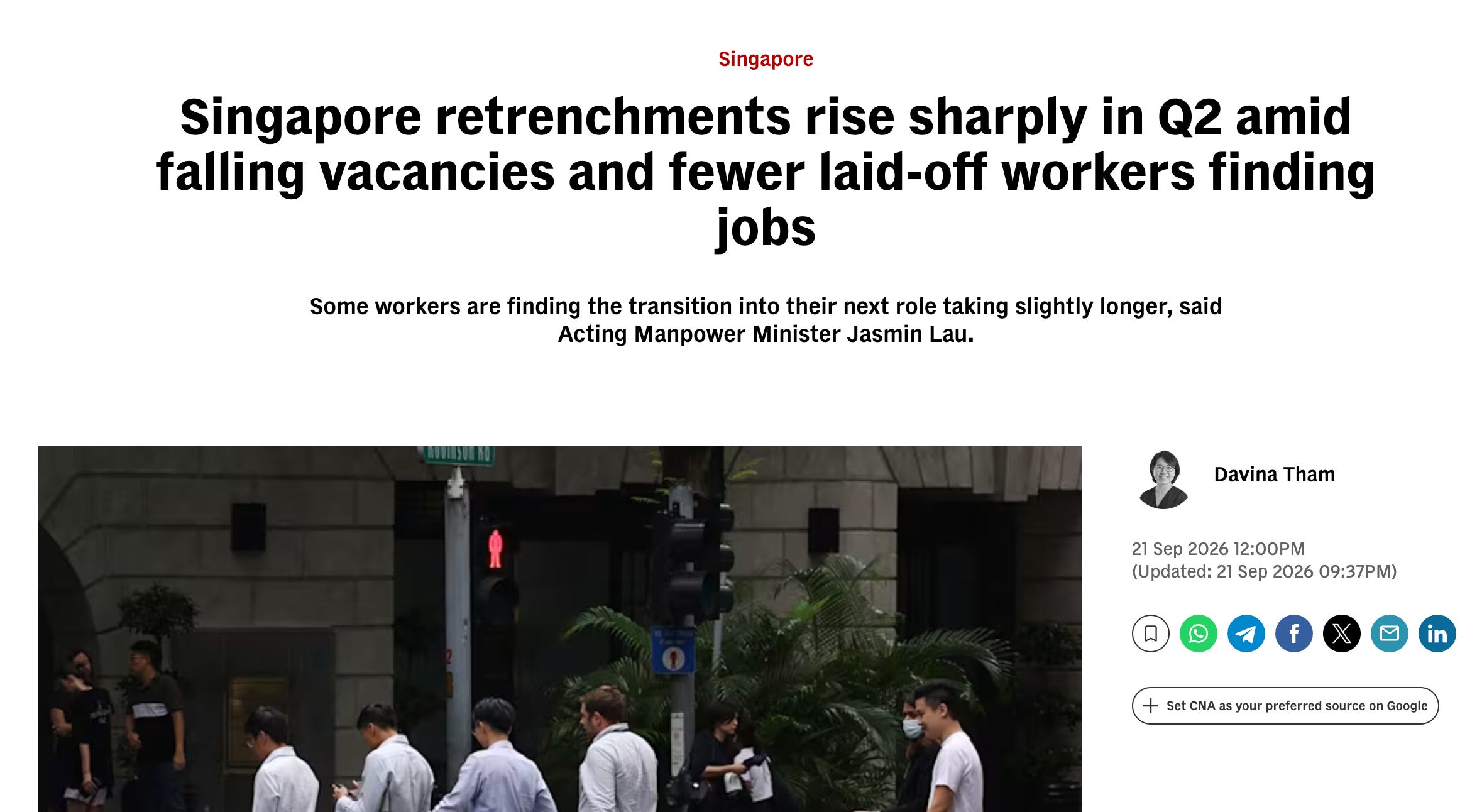
If you believe the stats, the overall job market is still “relatively healthy.” That’s no consolation if you’re the one who got the letter. Nobody gets laid off, reads the news, and feels better about it.
Getting back in is also taking longer. About 55% of retrenched residents found a job within six months. The quarter before, it was 60.7%.
Then there’s the price. Picture a professional earning $8,400 a month, the median pay for PMEs. They get retrenched, and six months later they land a job paying $6,000. The stats will call that a successful re-entry.
What it actually is: six months without a salary, then a pay cut of almost 30%. In sales terms, you closed the deal. You just sold at a huge discount.
So I won’t pretend I have a magic formula for landing a premium. For most of us right now, the goal is getting a foot in the door.
Why listen to me
I spent a decade running my own recruitment company. That’s ten years on the buyer side of this sales job. I’ve seen the applications that get a callback, and the ones that get deleted in seconds.
I also co-wrote Everything You Wish to Ask a Headhunter with Steven Pang, a guidebook answering the questions job seekers are too afraid to ask recruiters directly. So when I say job search is a sales job, it’s not a theory. I’ve been the customer, and along the way I’ve been on the selling side too.

Stop spamming
If job search is sales, why do so many of us do it like the worst salesperson in the office?
Same pitch for everyone. Blast it to 500 leads. No research, no follow-up, no tracking. Then wonder why nobody’s buying.
There are now tools that will auto-send 500 applications a month for you. That’s spam lah, and spam gets filtered.
Here’s the playbook instead. Six things: where to sell, how to prospect, how to fix your pitch deck, how to work warm leads, how to manage your pipeline, and how to close.
1. Pick your territory
Every good salesperson knows it’s much easier to sell where people are already buying.
A recent CNA commentary pointed out that total employment grew by 11,000 in Q2. Most of that went to non-residents, mainly work permit holders in construction and manufacturing. Resident employment grew by only 2,000-plus. So yes, jobs are being created. Just not necessarily for the person who got retrenched from a bank last month.
Before you send another application, ask where the money is flowing. Right now the answer is simple: AI. Ride that wave.
The wave is bigger than AI companies, though. Look upstream and downstream:
The infrastructure. Chip makers, data centres, the power and cooling AI runs on. VSMC recently opened its first plant in Singapore. They don’t do AI, but they supply the companies that do.
The adopters. Every bank, hospital and retailer that now needs people to implement AI, train staff on it, and govern it.

And look away from the sinking ships. Shopee cut 8% of its developers. DBS said it will phase out about 4,000 contract and temp roles over three years while it hires for AI. F&B lost about 3,000 jobs in the first half of the year because of rent and costs. Different reasons, same lesson. If the industry is sinking, applying harder is like going door to door selling fax machines.
Move one step sideways, into the role right next to the wave. If you need new skills, train for them, but train for a real job and not a hope. Acting Manpower Minister Jasmine Lau put it well: career conversion programmes should train people for actual roles companies need, instead of teaching a new skill and hoping a job turns up that uses it.
If you want to spot which companies and sectors are shedding jobs, check layoffsg.com, the layoff tracker I run. It’s historical data, but history is a decent teacher. The patterns there are the ones you may want to avoid.

2. Prospect for advice
Stop asking for a job. Ask for advice instead.
When you message someone with “Do you have any openings?”, you’re asking them to make a decision. The easiest decision is no, or silence. Try this instead: “I’m exploring a move into your field. I’d love your advice on how to approach it.” Now you’re asking them to be the expert, and people love being the expert.
Advice conversations also have a funny habit of turning into “Actually, you should talk to so-and-so.” I’ve seen it happen many times.
When I was doing business development, I never pitched clients directly. I’d tell them, “I just joined this company. This is what we do. Not sure if it’ll work for someone like you. Can I get your advice?” Six out of ten agreed to talk to me. There’s a saying in startups: ask for money and you get advice; ask for advice and you get money. Same thing applies to job search.
3. Let the leads come to you
The best salespeople don’t only chase leads. They get leads coming to them. For a job seeker, that’s content.
You don’t need a big following. You need maybe 50 of the right people to see that you think clearly about your field. One post a week about what you know is a billboard that works while you sleep.
This is how I got into HR tech. I’d been writing about it for years. At an event in India, the company’s marketing person recognised me from my writing, and within minutes we went from chatting at the booth to them telling me they were expanding to Singapore. My last job before going independent came the same way: my ex-boss appeared on my podcast, and I’d been telling all my guests I was on the lookout.

I’m still doing it now. When a few contracts got cancelled, I started a marketing newsletter to put myself out there. Within the first month, two prospects came in. Neither has closed yet, but I’m pointed in the right direction.
So if you know what you’re specialising in, write about it. Or make videos. Whatever works, as long as people start to see you as the specialist.
3. Fix your pitch deck
Your resume is your sales deck, and it has two audiences: the machine first, then the human.
The machine. Most companies run resumes through an applicant tracking system (ATS) that scans for keywords from the job description. If your resume says “managed client relationships” and the job ad says “account management,” the machine may not connect the dots. Even in the age of AI, some of these older systems are still quite stupid.
So mirror the language of the job ad, but only for things you’ve actually done. To check, tools like Jobscan and Teal compare your resume against a job description and show which keywords are missing. There’s also a Singapore-built one called ApplyLah that tailors your resume to each role using only your real experience.
The human. Once you get past the machine, a person takes a look. Give them results instead of responsibilities, and numbers instead of adjectives. Honestly, ChatGPT can help you with most of this today.
Want to go further? For your dream company, print a hard copy, figure out who the decision-maker is, and mail it to them. You don’t need to do it for every application. For the one you really want, why not?
4. Work your warm leads
Every salesperson knows a warm lead beats a cold call. In hiring, the warm lead is a referral.
Referrals make up only about 7% of applicants, yet studies have found they account for 30 to 50% of hires. Referred candidates are about four times more likely to get hired. Newer data is more conservative, but the pattern holds: a tiny share of applications, a big share of hires. It makes sense. When someone refers you, they put their own reputation on the line.
So the real question is who you know, and who they know. Most of us are terrible at answering that. Thousands of LinkedIn connections, old colleagues, contacts in our phone, and we can barely remember who’s where now. A tool like Happenstance helps. It searches across your network to find who you know, or who can get you to the person you want. If your connections also use it, you can see their networks too.

A friend of mine spotted a Lego job posted by their talent acquisition person, who was asking for recommendations. He started a group chat and got about ten of us to comment on the post. Every comment said the same thing: “You should talk to Michael.” If you were that recruiter, who would you call? Michael didn’t get the job in the end, but I thought it was a clever approach.
How aggressive you want to be is up to you. At one of my previous jobs, my boss ran the Korea office and went a full year after set-up with zero business. So he started camping on the ground floor of a target customer’s building, chain-smoking, because he knew exactly who he wanted to meet (and hope to “bump” into at the smoking corner). Months later, he finally bumped into that person, made small talk, and eventually won their business.
I’m not asking you to sacrifice your lungs lah. The point is that the people who can say yes to you have lives. They play golf. They do charity work. Know where to find them, and when to lean in.
5. Manage your pipeline
No serious salesperson keeps 50 deals in their head. They use a CRM like HubSpot or Salesforce. You should too.
Track every opportunity: company, contact, stage, last touch, next step. Most deals, and most jobs, are lost in the follow-up. The recruiter says “I’ll get back to you soon,” two weeks pass, and then what? Do you follow up? Do you even remember?
There are free tools built for this. Huntr gives you a Kanban board that moves each job from saved to applied to interview to offer. Teal has a free tracker too. If all that feels like too much, a spreadsheet works fine. What matters is that you use something.

6. Close at the right price, then keep selling
Here’s the best news in this whole post. In a sales job, you have to hit quota every month, every quarter, forever. In job search, you need one customer. You don’t need 400 applications. You need one employer to say “we want you.”
That changes how you spend your time. Fewer leads, better leads, warmer leads, proper follow-up.
I’m not going to pretend the market isn’t bad right now. But that’s outside anyone’s control. Your better bet is to outpace the competition by doing the things they won’t do, because those things are hard.
Remember the $8,400 professional who came back at $6,000? A good salesperson doesn’t only close. They close at the right price. The more warm leads you have, the less pressure you’re under to take the first discount on the table.
And once you close, don’t stop selling. There’s no such thing as loyalty these days. Keep having those coffee conversations. Keep your pipeline warm, because there will be a next time, and you don’t want to start from zero.
The best time to sell is when you don’t need to. It’s like borrowing from a bank: the best time to ask is when you already have money. When you’re down and out is exactly when the bank won’t lend.


