

Featured: The AI Gadget I Actually Use — PLAUD Note Pro

I test a lot of productivity tools. Most promise to save time. Few actually do.
The PLAUD NOTE Pro is one of the rare exceptions.
It’s a small AI voice recorder that captures meetings, calls, interviews and conversations, then automatically generates transcripts, summaries, action items and key takeaways. Instead of frantically taking notes, I can stay focused on the discussion and review everything afterwards.
For anyone in marketing, HR, sales, consulting or content creation, that’s a huge advantage. I’ve used it to capture podcast interviews, client meetings and brainstorming sessions. Often turning a one-hour conversation into usable content within minutes.
What I like most isn’t the hardware. It’s what happens after the recording. The AI helps surface the important moments, so I spend less time organising notes and more time acting on them.
If you’re someone whose best ideas happen during conversations, this is a tool worth looking at.
Disclosure: If you purchase through my link, I may earn a commission at no additional cost to you. I only recommend products I genuinely find useful.
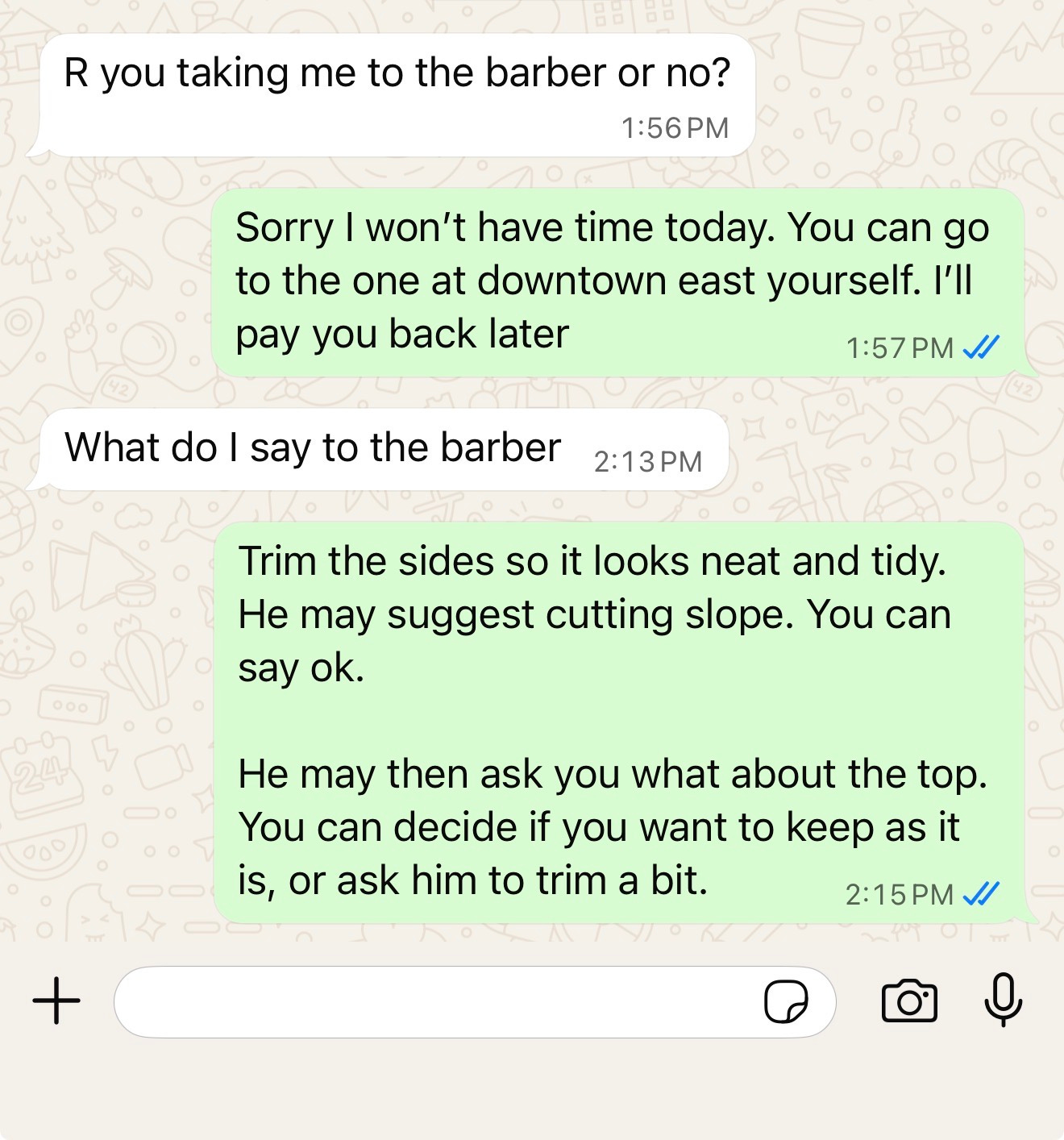
My younger son texted me on a school day to ask if I could take him to the barber. He is 13.
I was buried at work, so I told him to go alone and I’d pay him back.
Then he asked what he was supposed to tell the barber.
I was tempted to tell him to figure it out himself. But I paused and typed out some instructions on the fly: keep the sides neat and tidy, a slope is fine if the barber suggests it, and decide for yourself whether to trim the top or leave it alone.
He went. When I saw him that night, he had a proper haircut.
But that exchange stayed with me.
When my kids were small, we had to teach them everything. How to crawl. How to walk. How to hold a spoon. How to use the toilet. None of it was obvious to them yet, so we taught them every skill, sometimes hand over hand.
My own father died when I was 13, the age my son is now. Everything after that, whatever needed learning, I learned on my own. Trial and error, with enough hard knocks to eventually get the hang of things.
It worked out for me. But it probably did because I got lucky, and luck isn’t something I can pass on to my kids through DNA.
Somewhere along the way, I forgot that.
I assumed that once they became teenagers, they would figure out the rest themselves. Or school would teach them. Outsourcing is tempting once the child in front of you looks less like a child.
But I had skipped the part in between.
I remember training my kids to get themselves home from school, from Marine Parade to Pasir Ris. I followed them a few times to check that the route was safe. On the last run, I trailed behind without letting them know I was there, just to make sure.
That was how I taught them when they were younger. I showed them what to do, watched them try it, then slowly stepped back.
By the time they reached secondary school, I assumed I could skip straight to the stepping-back part.
That was naive of me.
A first crush. A first fight. Falling out with a friend. Walking into a barber shop alone and explaining what you want. Teenagers do figure these things out, but sometimes through knocks they did not need to take.
They still need guidance. I had simply stopped giving as much of it.
I saw the same thing when I taught at ITE.
Many of the students were still trying to work out what they wanted and how to move forward. Yet discipline often became the priority. Miss an assignment or fall short on attendance, and suspension followed.
I found that backwards. These students needed more help, not more punishment. We treated their mistakes as acts of defiance when sometimes they were signs that nobody had shown them how to manage what was expected of them.
I worked with a lecturer who had gone through the ITE system himself. He told me stories about getting into so much trouble as a student that he nearly ended up in a boys’ home.
I thought that history would make him more patient with the students in front of him. Over time, he became one of the lecturers who suspended kids for almost anything.
We were all teenagers once. Yet it is easy to forget what being one felt like: the not-knowing, the uncertainty, the stress of figuring out a body and a world that kept changing around us.
Their problems look small because we have already survived our versions of them. We know that a bad haircut will grow out, a crush will pass and one quarrel probably will not end a friendship forever.
They don’t know that yet.
My father was no longer around to teach me those things. I learned them through trial and error because I had no other choice.
My children do.
My son decided for himself whether to trim the top or leave it alone. I gave him enough information to walk into the shop by himself, then left one decision to him.
That may be what guidance looks like when your children become teenagers. You stop holding their hands, but you don’t stop telling them what they need to know.
That afternoon, it took five lines of text before my son left the house.
Next time, I want to remember to send them.