

The daughter came home last week waving her test paper like she’d just won the lottery. 98 out of 100. Eyes bright, grin enormous. And the first thing out of a parent’s mouth? “Where did the other 2 marks go?”
If that scene made you wince a little, good. Because that instinct to immediately locate the gap instead of celebrating the ground is exactly the problem Tim Ferriss was circling in his recent piece on the self-help trap. His line hit me cold: to continually improve yourself, you must continually locate the ways you are broken. We’ve built an entire culture around doing exactly that, and we’ve gotten very good at it.
Singapore is a spectacular case study. Back in 2016, PM Lee told us to have Divine Discontent — never to be fully satisfied, to always be reaching. Noble idea. Except somewhere along the way, Divine Discontent stopped being a personal philosophy and became a national anxiety. Ministers remind us to reskill and upskill or risk irrelevance. Every other LinkedIn post screams that 90% of people are using AI completely wrong. Oh, and if you want the cheat code, just comment WOOHOO and they’ll DM you a PDF (that nobody reads past page 3).
I should know. I have a Notion page stuffed with AI prompts I’ve collected like a man preparing for an apocalypse that requires very specific text inputs. You know what that Notion page taught me? That I am an excellent collector of prompts. That’s it. That’s the whole lesson.
And here’s the phrase we’ve collectively forgotten how to say: good enough.
Not in a defeatist, give-up-and-rot sense. But in the honest, clear-eyed sense of: I am doing well. The goalpost keeps moving, and maybe I should stop chasing it. You score 100? Now you need to score 100 consistently. You graduate from a local university? Last generation, that was a golden ticket. Now you need seven internships, a specialisation, an online certification, a side hustle, and probably to make offerings at Tua Pek Kong for 49 days straight. And still, maybe, possibly, a job.
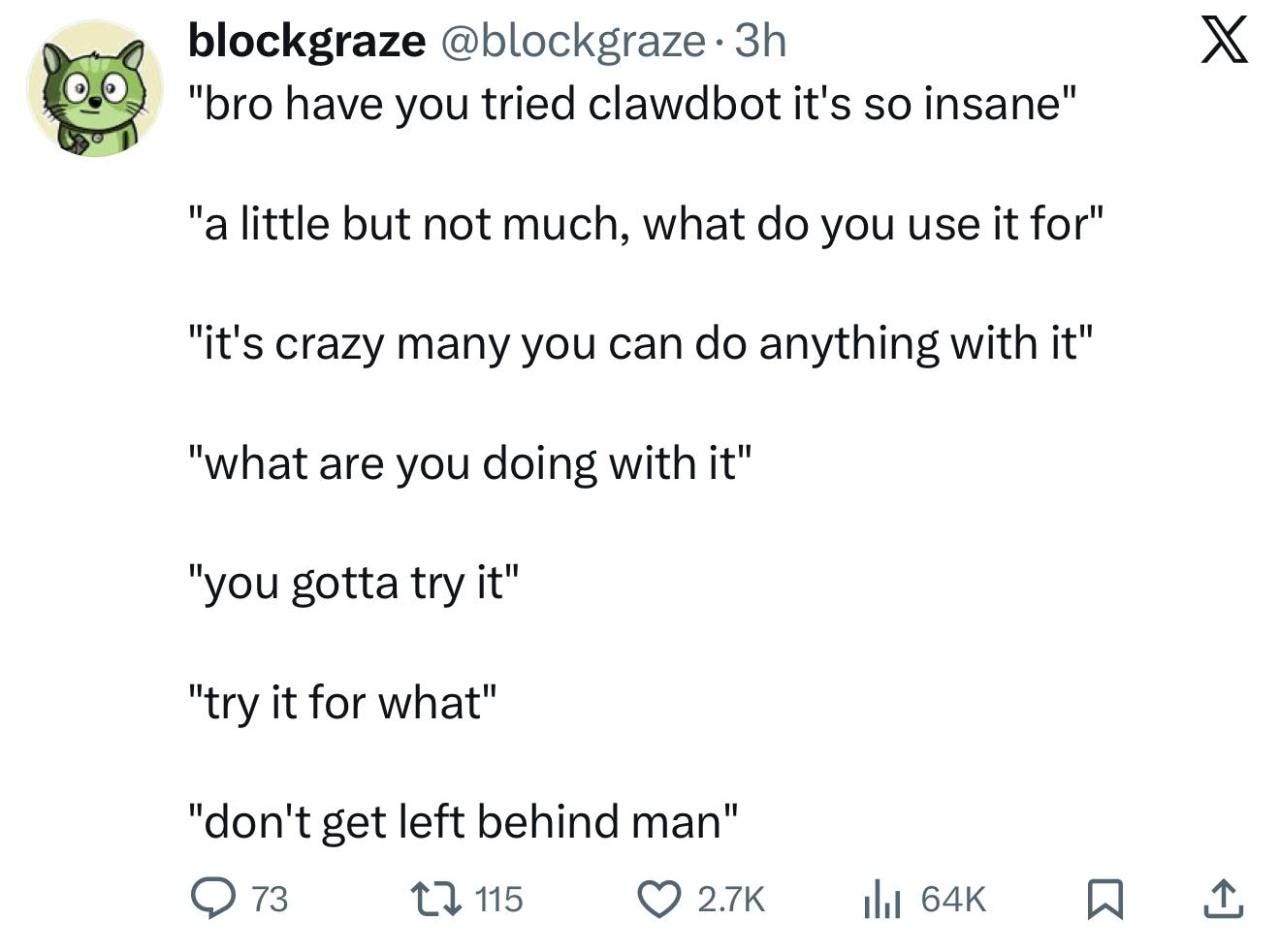
This screenshot I’ll drop here says it all. Nobody — nobody — needs anything that sophisticated. We’re solving problems we don’t have with tools we’ve barely started using.
Ferriss puts his finger on something deeper, though: the optimisation obsession starts with a foundational belief that you are broken. That the glass is perpetually half-empty when it comes to yourself. Keep seeing yourself that way long enough, and it stops being motivation — it becomes a kind of low-grade misery you’ve learned to call productivity.
Think of it this way. You finally add a car perfume to your car after years of meaning to. Does the car suddenly feel new again? For about four minutes, maybe. That 0.00001% improvement you chased didn’t change anything fundamental. But somehow we keep believing the next upgrade will be the one that finally makes us feel complete.
Most of us are, in fact, doing remarkably well given everything we’re dealing with. That deserves more than a footnote.
So what instead? Not nothing. Not abandoning growth entirely. But maybe redirecting the energy toward what actually matters — friends, family, a hobby you do just because you like it, meals you cook for someone else, conversations that don’t have a productivity angle. Anything, really, except trying the new technique that meshes Pomodoro with time-blocking while listening to a binaural beats playlist your LinkedIn connection swears by.
Life is already here. Already happening. Already, in most of the ways that count, pretty good.
The 98 marks are right in front of you.