

A few years ago, I was at a friend’s place in Australia. Her husband has the kind of hobby roster that feels almost offensive to look at. Aquatic plants in a custom tank. A BBQ setup he treats with the seriousness of a surgeon. A sound system he built himself. Woodworking projects in various states of completion.
My first thought — embarrassingly honest — was: must be nice to live in Australia.
Work-life balance. Shops that close at a reasonable hour. A culture that doesn’t celebrate staying at the office until 9 pm as a personality trait. I told myself that’s why he has time for all this, and I don’t.
Then I caught myself.
He has 24 hours a day. I also have 24 hours a day. The math is the same. The question isn’t time. It’s what fills it.
I’ve been thinking about this a lot lately. Specifically about how I spend the hours that aren’t work. The honest answer, for a long time, was: social media rabbit holes. Netflix until I couldn’t keep my eyes open. The particular exhaustion of consuming a lot while doing nothing.
Recently, I built a book nook. If you haven’t seen one: it’s a miniature diorama — in my case, a tiny Shakespeare bookshop, complete with shelves, a staircase, and a sign that reads “Welcome to My Book Store” — that sits between books on a shelf. It does nothing. It solves no problem. It cannot be monetised. I bought a kit on a whim and spent many afternoons assembling it, and somewhere around the third tiny shelf I realised I hadn’t looked at my phone once, hadn’t thought about work, hadn’t thought about much at all except whether this miniature plant was going in the right corner.
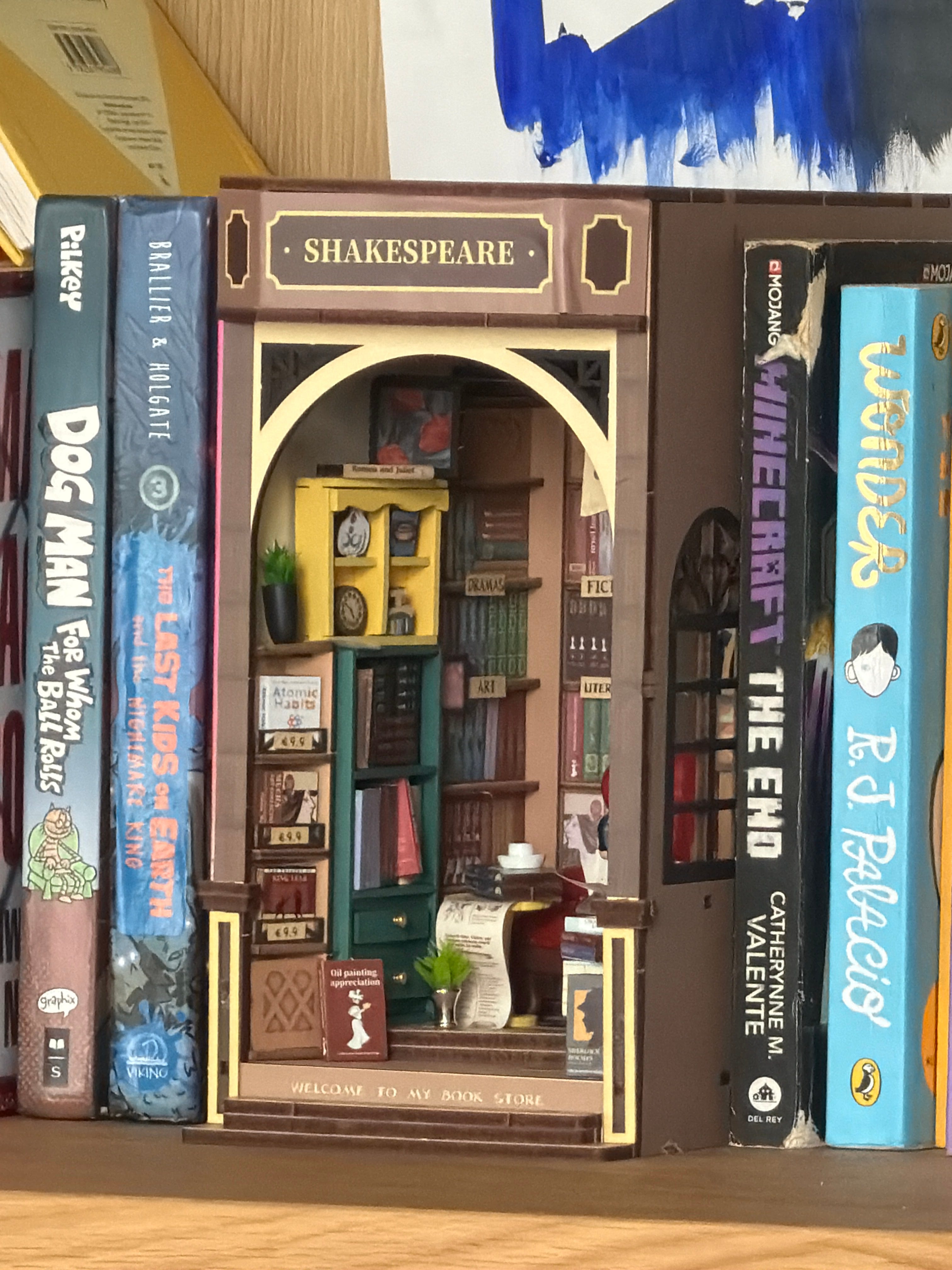
I felt better afterwards than I had in weeks.
There’s a name for this. Psychologist Mihaly Csikszentmihalyi spent decades studying what he called “flow” — the state of being fully absorbed in a task, where self-consciousness drops away and time stops registering normally. The activity has to be the right level of challenging: too easy and your mind wanders, too hard and you freeze. Building flat-pack furniture, apparently, sits right in that sweet spot for me.
The research on hobbies is more robust than you’d expect. A 2023 study published in Nature Medicine tracked over 93,000 people aged 65 and above across 16 countries for up to eight years. People with hobbies consistently reported better health, greater happiness, and fewer symptoms of depression than those without. That’s not a small convenience sample. That’s a serious longitudinal study across diverse cultures pointing in the same direction.
At the neurological level, engaging in an enjoyable hobby triggers the brain’s reward system, releasing dopamine — the chemical tied to pleasure and motivation, which then reinforces the desire to do it again. It’s one of the few legal, free ways to reliably hack your own reward circuitry.
There’s also a stress angle. One study found that roughly 75% of participants saw their cortisol levels drop after making art — even those who didn’t identify as artistic. The act of making something with your hands, it turns out, has a physiological effect that passive consumption simply doesn’t replicate.
But here’s what I find most interesting, and what I think is most relevant for people like me who have spent years optimising everything: the identity buffer argument.
When your professional identity is the only one you have, any failure at work becomes a failure of self. A bad performance review, a project that doesn’t land or a period of unemployment all start feeling like existential threats. You’ve put all your eggs in one basket.
I felt that after exiting from my recruitment business after 11 years. Without any other identity, I was thrown straight into an identity crisis which took months to get out of.
A hobby cracks that open. If you’re also someone who grows aquatic plants, or builds speaker systems, or does weekend barbecue with genuine investment, a bad week at work is still a bad week at work, but it doesn’t touch the part of you that knows how to keep a planted tank alive. Your self-concept has more surface area. It distributes the load.
One scientific review catalogued more than 600 distinct ways hobbies can benefit people — from reduced stress and improved mood to the development of creativity, resilience, and self-confidence. Six hundred!
There’s a particular trap worth naming here, especially for people with an entrepreneurial reflex: the temptation to monetise.
The moment a hobby becomes a side hustle, something changes. The thing you did because it absorbed you completely is now subject to performance metrics. Are people buying? Is the audience growing? Could this scale? The frivolousness and the uselessness were precisely what made it work. Turning it into a revenue stream strips the very quality that gave it its restorative power. And the exhaustion from managing a side hustle has a way of bleeding into everything else.
Some things are allowed to just be for you.
I know the objection. I’ve made it myself. Time is the real constraint. Between work and family and the ten thousand administrative tasks that constitute modern adult life, where exactly do the hobbies go?
But I keep coming back to my friend’s husband and his aquatic plants. He’s no less busy than me in any meaningful structural sense. He’s made a different set of choices about what the non-work hours are for. Something more like an investment in a version of himself that isn’t legible on a CV.
If you spend three hours a day on your phone — which, per most screen time reports, is a conservative estimate for a lot of us — and redirected even 15 or 20 minutes of that toward something that required your hands and your full attention, the research suggests it would matter. Not in a productivity-hack way. Not in a way that optimises your output or builds your personal brand. More quietly and durably, being good at something for no reason tends to matter.
The frivolousness is the point. That’s what makes it work.