

My IHRP Senior Professional certification expired on 17 April 2023. I didn’t renew it. I just could not figure out what it was doing for me that justified the paperwork since I wasn’t even a practising HR professional.
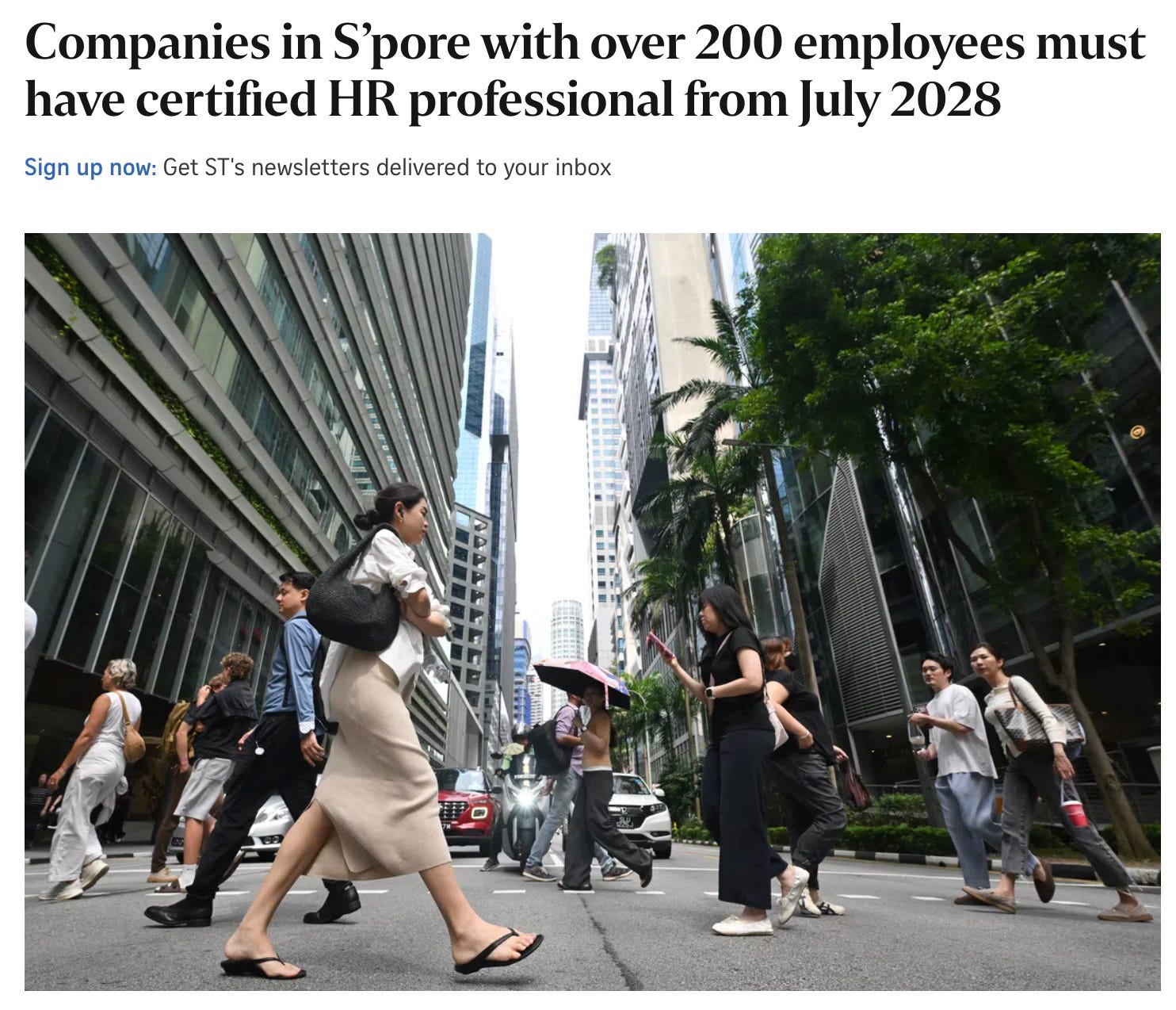
But from 1 July 2028, every one of them in Singapore companies with more than 200 employees will need what I let lapse.
I spent ten months inside IHRP in 2021, on the leadership team. Long enough to see the grant taper start but not long enough to see where it lands. You see, IHRP was set up by MOM, NTUC and SNEF. For those of us who are familiar with these 3 organisations, you can already tell where the money is coming from.
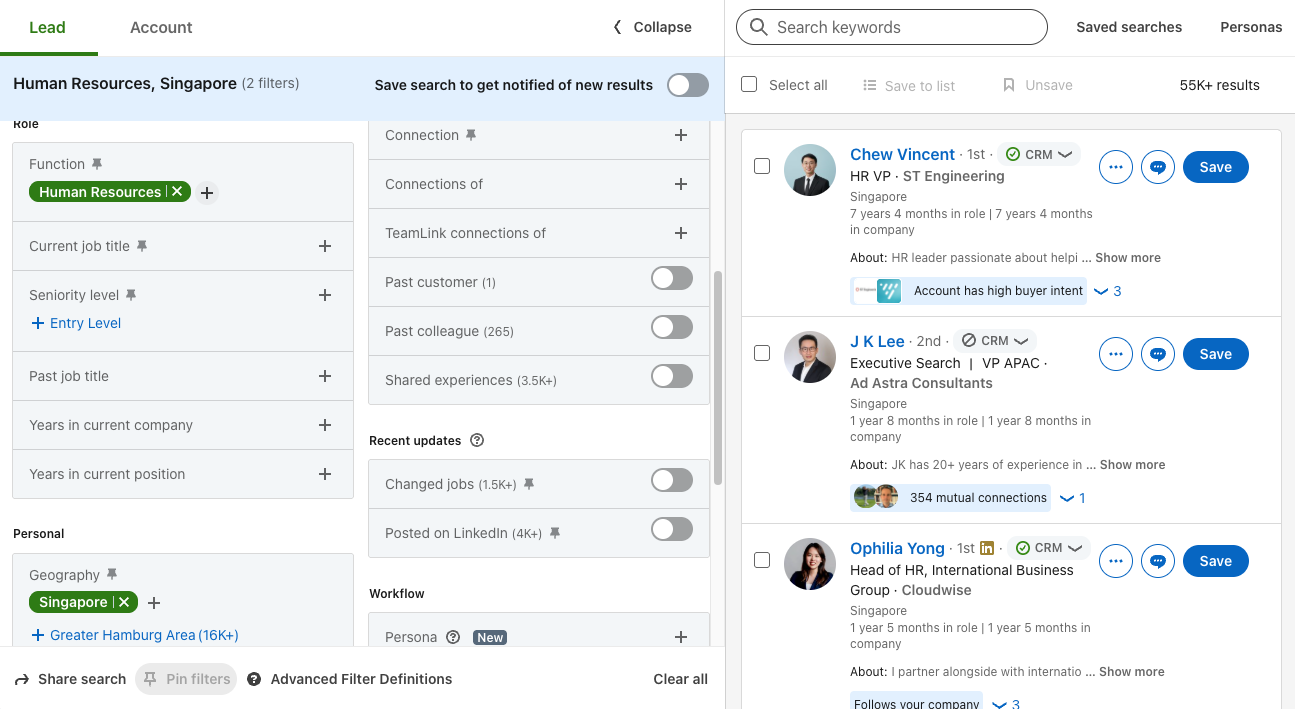
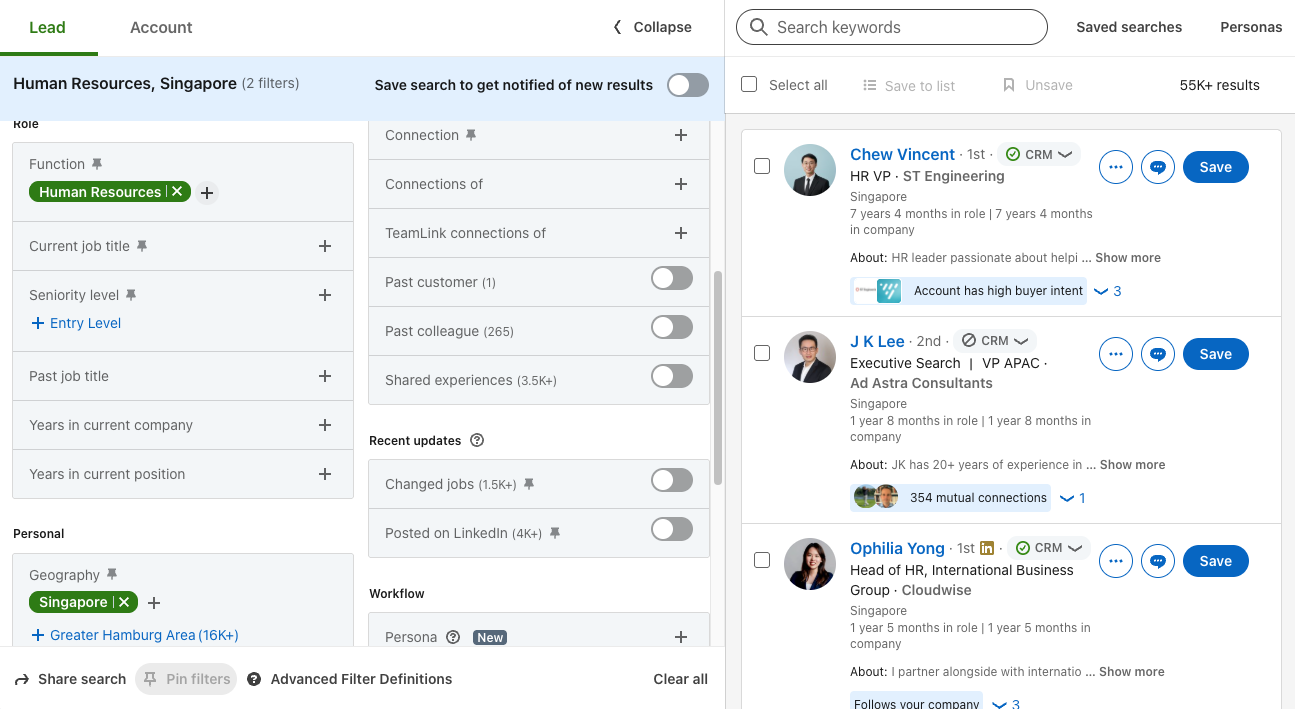
And 9 years after the IHRP certification launched, the number of people it has certified sits at around 9,000. According to LinkedIn, Singapore’s HR headcount is roughly 55,000. So after nearly a decade, with tripartite backing and government subsidies, IHRP has certified only 16% of the HR population in the country it exists to professionalise.
Hence the lofty goal of hitting 18,000 certifications by 2030. Which sounds noble… if one is forgetful.
Because in 2022, NTUC and SNEF shook hands on 12,000 IHRP-certified professionals by 2025. That did not happen. In 2023, the number was set to reach 15,000 by 2027.
Going by the pace of the last few years - about 700 new certifications a year - 2027 is fifteen months away, and there’s no way they clear it. So this month, the number reset again: 18,000 by 2030. Quite similar to our World Cup Goal 2010. Big words, little action.
A business that keeps missing its own numbers and announcing a new one instead of explaining the last looks less like progress and more like resetting the goalposts, with a press release each time.
Roughly less than 2,000 companies in Singapore have more than 200 staff. About 900 already have a certified HR person. That leaves 1,100 companies who, as of the new law, are now IHRP’s customers whether they wanted to be or not. Getting to 18,000 by 2030 needs about 2,250 new certifications a year, more than triple the recent pace. The gap between what the market wants and what the target needs is exactly the size of the mandate.
When I was there in 2021, on the leadership team, drawing a comfortable five-figure monthly salary, I was told the operating grant was already down to 75% and tapering to zero. I was, for ten months, a line item in that headcount-to-grant math myself.
IHRP was meant to stand on its own two feet eventually. I don’t know what percentage the grant is on now. What I do know: headcount was about 30 when I was there in 2021; it is now closer to 40.
The certification fees remained highly subsidised, from $163.50 to $272.50 once every three years, and a growth rate that’s been slowing for three straight years. The arithmetic doesn’t close on its own, and I’d guess plenty of people inside suspected as much. Which might be exactly why the government just handed it 1,100 new customers by law, plus a fresh $100 subsidy so the cheap version stays cheap enough that nobody complains.
Even if IHRP hits 18,000 on the nose, the money barely moves. Call it 1,100 new certifications, mostly at the cheaper end, subsidised down to $163.50 every three years. That’s something like $60,000 to $100,000 a year in fresh amortised revenue, against a gap that, by my own rough maths, likely runs into the millions.
Compare that fee to the neighbours. PMC, the equivalent lean-body cert for management consultants, runs you close to $4,000 all in. SHRM, the American one, is $500 to $2,000 depending on how you shop. CIPD, the British one everyone name-drops on LinkedIn, starts around $2,700 and climbs past $6,500. IHRP: $163.50 to $272.50, every three years, subsidised down further from there. For the only certification about to be written into Singapore law, that’s an odd place to sit.
They do have other products but it barely moves the needle. The Human Capital Diagnostic Tool is free to companies, and the assessor-led version was, at least at one point, fully funded by MOM. Spending someone else’s money doesn’t count as diversification. Skills Badges are earned through courses run by other training providers. IHRP stamps the badge; the course fee goes mostly to somebody else.
The events business, though, is the real thing. Sponsorship for their flagship forum runs from a few thousand dollars for a logo on a webpage up past fifty thousand for the top tier. That top tier alone costs more than 300 individual HR certifications.
The pitch to sponsors is that a large share of the community is HR directors or above, from MNCs and large local companies. That’s a genuinely valuable audience, and somebody at IHRP clearly knows how to price access to it. The credential that audience is supposedly built on still costs less than a nice dinner for two, once every three years.
Ten years running my own recruitment firm’s P&L taught me one thing: you don’t cross-subsidise your way to sustainability forever with programmes that cost more to run than they bring in, while the one thing you actually sell is priced like an afterthought.
Because if you do the maths on nine years of payroll, rent and programmes, even roughly, you land somewhere north of $25 million. For comparison, a Louis Vuitton Speedy 25 retails for $2,760. Multiply that by every HR professional IHRP has ever certified and you land in almost exactly the same place. On a back-of-the-envelope basis, it might genuinely have been cheaper to skip the accreditation altogether and just buy all 9,000 of them a bag.
All that is fine if these are private monies, but it isn’t.
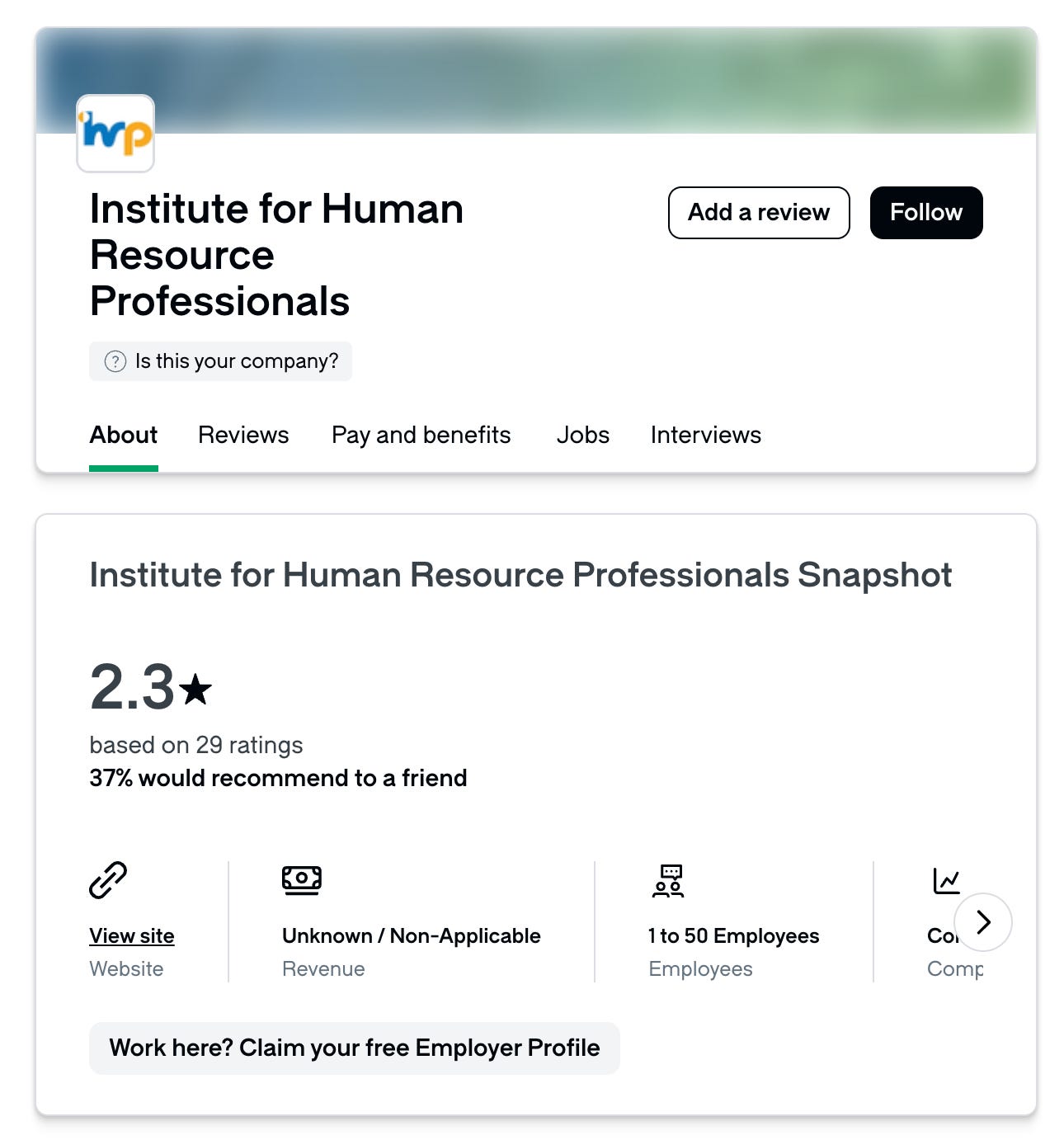
Worse still, this is also a body that grades HR practice nationally and scored 2.3 out of 5 on Glassdoor from its own staff, with only 37% saying they’d recommend working there. So what HR best practices are they trying to inculcate? Not to be like them?
It also holds a Great Place To Work Singapore award through next year. I don’t know how both of those are true at once, and I suspect IHRP doesn’t either.
If you ran a business like this, on a credential priced like a rounding error next to your own sponsorship rate card, with output missing its own forecasts for three years running, someone on your board would ask whether it needs the kind of shelter HCLI eventually got.
HCLI launched in 2010 backed by a ministry, a university and a statutory board, not so different from IHRP’s own tripartite start. It ran that way for seven years. In 2017, Temasek Management Services folded its own leadership arm into HCLI, and what came out the other end kept the name but became a permanent subsidiary of TMS, tucked inside a sovereign wealth fund’s balance sheet ever since. IHRP was supposed to be different: taper the grant, live off its own fees. I wonder which version it ends up being.
Somewhere in my inbox is still the email telling me my IHRP-SP lapsed on 17 April 2023. I never worked out what I was paying for. From July 2028, two thousand companies won’t get to make that choice. For them, it won’t be an email. It’ll be the law.