

Charlie Munger, at one of his final birthdays, was asked what he wished for. His answer: to be 83 again.
Here was one of the wealthiest, sharpest minds alive — a man who could literally buy almost anything — and his greatest wish was simply more time. Not more money. Not more status. Time.
That’s the cruellest joke of life. You can compound your wealth. You cannot compound your years.
Sit with that for a moment. I’ll wait. (Unlike time, which will not.)
We All Live Like We’re Immortal
For the longest time, I was firmly in this camp.
Save more. Spend less. Delay gratification. Retire comfortably. Die... having done what, exactly?
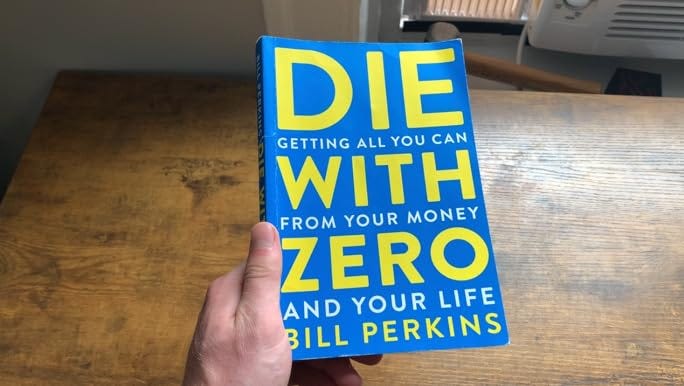
Confronting your mortality is deeply uncomfortable. Almost as uncomfortable as discussing finances with your spouse — and if you’ve attempted that conversation, you know exactly the specific silence I’m describing. But Die with Zero by Bill Perkins forced me to do both, and I’m genuinely glad it did.
(My wife is also glad. Mostly because it means I’ve stopped judging her Grab Food orders as “unnecessary spending.”)
Three chapters left a deep impression on me. I’ll save my favourite for last, so stay with me.
CHAPTER 1: We Don’t Retire with Money. We Retire with Memories.
When we’re on our deathbed, the account balance is meaningless. The memories are all that remain.
One of my most vivid memories is a trip to Hong Kong with colleagues from my first job. We were earning $1,500 a month — and this trip cost a significant chunk of that. Worth every single cent, and I remember it far more clearly than whatever I spent the other months’ salary on. (Probably nothing exciting. Probably chicken rice.)
Here’s something Perkins made me realise: there are experiences you can only have when you’re young. A backpacking trip. Staying in hostels. Sleeping on a cold wooden bench at the firing range during NS — I did this, effortlessly, at 18. I couldn’t now if you paid me and provided a chiropractor on standby.
By your mid-40s, travel looks different. You’re constantly yawning. Your body needs two days to recover from one day of fun. You’ve developed an eight-step bedtime routine and you will tell people about it unprompted. How do you build great memories when you need a risk assessment before staying up past 11pm?
The book also makes a reassuring point for younger readers: your income almost certainly grows over time. You can make up the savings shortfall later. You cannot un-miss experiences.
CHAPTER 2: Think of Your Net Worth Peak as a Date, Not a Number
I know people in their 80s who still manage five properties, obsess over yield optimisation, and calculate rental returns at the dinner table. The time they spend playing landlord logistics could be spent living — but more pressingly, it could be spent not making everyone at dinner very uncomfortable.
Perkins cites a striking example: if you die with $130,000 unspent and you spend $32,000 per year, that’s 6,600 hours of your life worked for nothing. Over two and a half years of 50-hour weeks. Gone. For money sitting in an account, quietly judging your heirs.
I was reminded of a conversation with Ashok Samuel, who was head of private equity at GIC. He told me simply: “55 is my retirement. No buts, no ifs.” Decisive. No hedging. Meanwhile, I’m over here negotiating with myself about whether I can afford an extra side dish.
A note on the numbers (because I know you’re quietly panicking):
Many people overestimate how much they need to retire. And I say this as someone who has definitely Googled “how much do I need to retire” at 2am and immediately felt worse about my life choices.
Here’s why the fear is overstated: your remaining money doesn’t sit still while you draw it down.
Say you have $500,000 saved and spend $30,000/year:
Your balance earns 1.5% interest → $7,500 in year one
Inflation at 3% adds only ~$900 to your annual expenses
Net: you’re still $6,600 ahead from interest alone in year one
Even as you withdraw $30k, your remaining $470k earns $7,050 the following year. The math is genuinely kinder than the fear. (And yes, this is precisely why financial advisors have every incentive to keep you saving longer than necessary — looking at you, and your very confident PowerPoint projections.)
CHAPTER 5 (My Favourite): Time-Bucket Your Life
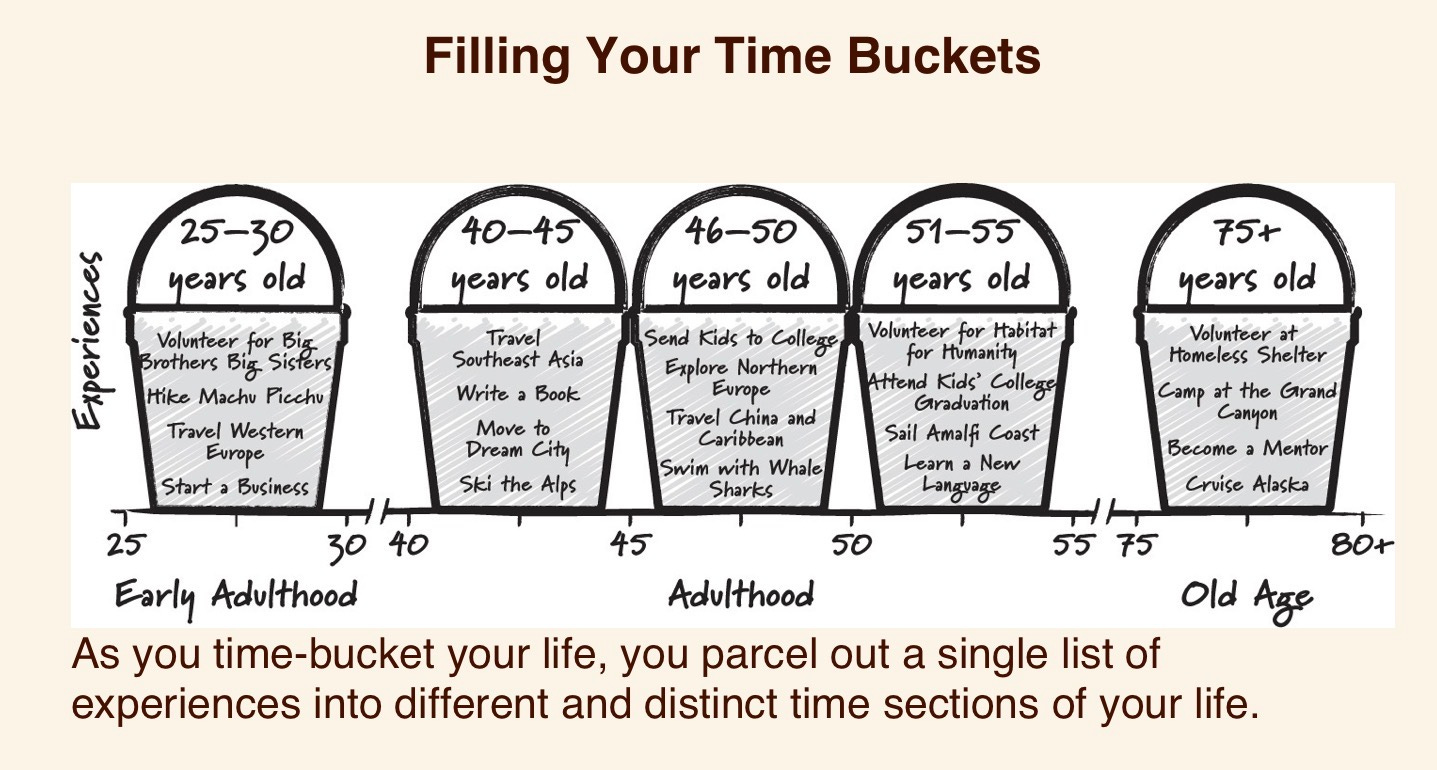
I have this on my wall now. My family thinks it’s morbid. I think it’s the most useful thing on the wall, which previously just had a motivational print I stopped reading in 2019.
The concept: draw a timeline from today to your expected death. Divide it into five or ten year buckets. Then list everything you want to experience — travel, giving, gardening, visiting every park in Singapore, learning something, building something — and assign each to the bucket where it realistically belongs.
What this exercise reveals is quietly devastating: you have far less time than you think.
I haven’t filled in my 70s and 80s yet. Partly because it’s a bit confronting. Partly because I’m hoping my 70s are still far enough away that Future Me can deal with it. But even seeing my 40s, 50s, and 60s laid out — with physically demanding travel needing to happen sooner, giving requiring financial readiness, and some experiences having hard expiry dates I never consciously acknowledged — it changes everything about how you prioritise.
A bucket list made at 70 is reactive. Time-bucketing is proactive. You stop drifting through life on autopilot and start making actual decisions — which, as it turns out, is both terrifying and oddly liberating.
The Business of Life is the Acquisition of Memories
Charlie Munger wished he could be 83 again.
You cannot buy time back. But you can choose, starting today, to stop treating your future self as the only one who deserves to actually live.
Save, yes. Be responsible, yes. But ask yourself honestly: where is your life energy going — and is it building the memories that will matter when the balance sheet is completely irrelevant?
I asked myself that question, and the answer was uncomfortable enough that I changed a few things. I’m a work in progress. But at least now I have a wall chart.
What’s in your time bucket?